The Fish
Tetraodon biolcellatus, commonly known as the figure-8 puffer, is frequently available in the aquarium hobby. It can be a rewarding pet, given their active and curious nature. They are colorful puffers, with pale bellies and green and yellow markings on their backs, typically reaching a size of about 3 inches. Their name comes from the two very dark marks on each side of their caudal (tail) fin, which can form a figure-8 pattern, but often looks like eye spots, or bi-ocellatus (two eyes). This is how you can easily tell whether you have a figure-8 versus some similarly marked puffers that can get much larger. They originate in Southeast Asia in freshwater locations that are slow-moving and shallow, where small crustaceans and snails are found. They enjoy an aquarium of at least 15 gallons, with the footprint longer rather than taller, because they spend time on the bottom and love to swim and explore. Calciferous rock and aragonite sand will help keep the pH raised in the tank to as high as 8 or greater for the health of the puffer, and the water temperature should be kept at 78-84F. Singletons seem to be the happiest and live the longest, but more than one could be kept if they are raised together from juveniles, and many keep them successfully with other small brackish species. You do not need to be an advanced aquarist to keep them, but you need to be comfortable with the basics and do your research prior to bringing one home.
The Water
You will find much disagreement on the subject of keeping the F8 puffer in brackish or freshwater in the home aquarium. A search on the topic will yield endless articles and forum threads on which is best, and, ultimately, they are frequently kept in both depending on preference. The fact is that they are found in freshwater locations in the Mekong (Cambodia), Malaysia and Borneo, and are shipped to distributors in freshwater, so your local shop will certainly receive them in such conditions. For simplicity’s sake, many shops will maintain them in freshwater and sell them as such, since it is often not cost-effective to set up and maintain a separate brackish tank for these fish. Information collected and reported by nature conservancies and environmental researchers such as FishBase make the distinction that this fish is “not a brackish species.”
However, research and anecdotal evidence compiled for many years on F8 puffers kept in aquaria seem to confirm that this species will enjoy a prolonged life, up to 15 years, if kept in lightly brackish water of around SG 1.005-1.008. Apparently, the immune system of the puffer is boosted and they are able to avoid succumbing to illness and parasites under these conditions, though hard scientific documentation of this circumstance is difficult to find. I personally consider the species to be best kept in brackish conditions, but this is a choice the fishkeeper needs to make on their own.
The Salt Mix
When keeping the puffer in a brackish setup, the salt used ought to be that intended for marine aquarium applications (table or human grade sea salt is not appropriate and lacks trace elements and calcium that is beneficial to the pH and the fish) and there are several ways to prepare the water to be used for future water changes. Some people mix large quantities of brackish water in dedicated trashcans or tubs, using water pumps to circulate the water and to pump it into the tank during water changes.
My method for a 20-long aquarium containing one puffer is to use a full marine mix prepared in 5-gallon plastic water jugs meant for water coolers. I typically purchase whatever marine mix I can find adequate for 10-gallons of water and split it between the two jugs, rotating/shaking the jugs until the salt mix is completely dissolved, and I’m left with full marine water. If you are using municipal water for your stored mix don’t forget to dechlorinate it as you prepare the solution. I stash these jugs in a closet until I’m ready for them. After vacuuming the tank and draining it by half, I begin to fill the tank with dechlorinated tap water like any other freshwater aquarium, but as I do so I pour in some of the dechlorinated marine mix water, which blends with the freshwater as it goes in, until I achieve the desired SG. I use a floating hydrometer and monitor this during the filling procedure, and keep the hydrometer in a corner of the tank at all times for instant reading.
Water changes are very important for these puffers, which do best with extremely clean water, and I generally change 50% of the water each week. Their meaty, messy diet means there is a lot of waste created by the fish and uneaten particles of food, so the bioload of one puffer is greater than that of a fish of similar size in the average freshwater tank. When doing water changes remember that any evaporation of tank water will concentrate the salts in the water, so you must utilize a hydrometer to monitor SG so it does not rise too much.
Please note that puffers are sensitive to toxins in the water, more so than other species, and must not be used to cycle a tank. The tank needs to be cycled prior to introducing the fish to the aquarium, using whatever cycling method you prefer.
The Selection of Your Puffer
At the store, the tank should be clean and not crowded. Look for a young puffer, and be sure to choose one that is active and seeking attention. Look at the belly and avoid the ones with a sunken belly; this is very common to see and is an indication the fish is not eating for one reason or another. If the belly is very slightly concave that is not of concern, since they have a fairly rapid digestive system, in my experience, and not too long after a hearty meal the belly has gone flat again. However, extremely sunken bellies are a common sight, either due to the shopkeeper not realizing what the puffer needs to eat (they will not take flake or pellet/prepared fish food) or due to illness.
Also make sure the puffer’s body is free of signs of ich or bacterial infections, and the fins are not split or cloudy. Some minor fin injuries are not unusual, however, especially when housed with other puffers, so the fish doesn’t have to be perfect, but be sure it is not ill or carrying a disease. The fins and the color of the puffer will improve in the home aquarium with target feeding and clean water, as well as appropriate tankmates or the comfort of a tank to himself.
The Acclimation
Care should be taken when introducing your new puffer to the home aquarium. As mentioned, the tank should be cycled prior to the new fish’s arrival, but keep in mind that the beneficial bacteria that complete the “cycle” of a freshwater aquarium are slightly different from those that cycle a saltwater setup; a sudden switch to brackish could disturb the cycle and harm the fish with toxic levels of ammonia and nitrite. If you determine that the puffer was kept in the shop in freshwater conditions, be sure to start him out in a freshwater tank at home. Gradually increase the specific gravity by 0.001 or 0.002 per week until you reach your goal, and the bacteria will proliferate along with the increase in salinity, keeping your tank healthy and cycled. The fish will also become acclimated to the brackish tank in a gradual fashion, which will result in a smooth transition to his new home.
The Tank
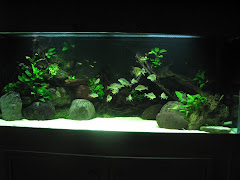
These puffers tend to be found in the benthic zone in nature, or the lowest level of the water near the substrate of the aquarium, due to their constant search for crustaceans and snails. They wander around, in continuous motion, searching the sand or gravel for prey. The puffer will appreciate adequate open space, but it is also important to provide rocks, small caves, archways and paths to other areas of the tank, separated by decor, to keep the puffer interested and prevent boredom. For this reason, as well as to provide the additional benefit of buffering the water, I prefer to use buffering sand (“cichlid” sand or aragonite/coral sand) as well as base rock (available for marine setups, used to propagate organisms for “live rock”) or other calciferous rock decor. I stack the rocks down the very center of the tank lengthwise, with caves and empty spaces in between so the puffer is able to travel to the other side of the tank and can enjoy a complex set of paths and trails to explore, with breaks in sight lines. A bored puffer will “pace” back and forth the length of the tank, and will be more likely to attack and disturb tankmates. Some aquarists use plastic tubes and other aquarium-safe objects to occupy the puffer’s time and drain their ample energy.
Filtration of the tank needs to be strong or even overdone in order to create a high turnover of water and maintain pristine water conditions, though a strong current is not appreciated by these fish. Again, Figure-8 puffers have no scales and are intolerant of ammonia or nitrite, so it is important to adhere to a strict maintenance schedule. It is possible to grow plants in brackish tanks, and Java fern (Microsorum pteropus) or Java moss (Taxiphyllum barbieri) is often chosen. Figure-8 puffers will not disturb plants unless they find an unsuspecting snail there.
The Diet
Puffers have teeth that are beak-like, formed by two plates. These teeth grow continually, so without the proper hard diet the teeth will need to be trimmed manually. This procedure can be done, and there is information available on the internet to help educate the puffer owner about it, but I prefer to provide plenty of mollusks, snails and crustaceans in their diet to mitigate the risks associated with teeth trimming. You can buy frozen seafood at the grocery store, like small clams, mussels, shrimp and crab legs, and thaw them out in cool water, breaking them up with a hammer or shears so the puffer has to scrape the meat from the shell, or crunch through the shell, which will keep the teeth pared down.
Another suitable food source is my puffer’s favorite: snails. Since the aquarium hobby is full of snails of varying species, they are usually easy to come by. Ramshorn snails are simple to propagate in a separate tank and fed to the puffer regularly. Pond snails and any other type of aquatic snail are also easily found, as many consider them a nuisance. Some of your fellow fishkeepers may have an unwanted proliferation of snails and will be happy for you to come over and collect them for your puffer. Snails can also be purchased from eBay, Aqua-Bid or other online sources for relatively low cost, added to a small tank of their own, fed veggies and allowed to reproduce for future use. The puffer diet should be varied, though, so alternating the type of meaty foods will ensure a healthy and happy fish. It can be quite fascinating to watch the puffer anticipate and tear into his meal, attacking the shell relentlessly with much vigor and enthusiasm. My own puffer will slap the surface of the water with his tail, sometimes splashing a bit onto the adjacent wall, to indicate that it is feeding time!
When the puffer eats they make a bit of a mess, and do not tend to go around and pick up tiny bits of food, so this is where attention to housekeeping comes in focus. During water changes you’ll be vacuuming up leftovers and bits of shell so they don’t accumulate and foul the water. For a sandy substrate I take my hand and gently wave it to disturb the surface and raise bits of leftovers so I can vacuum them up without siphoning out the sand. You can also use a spatula or other device to stir the water gently to lift debris for removal.
The Puff
Finally, let’s address the issue of puffing. This is, of course, a fish that is known to inflate its body with water or air as a defense mechanism, making it larger and more intimidating, or to make it appear unappetizing and difficult for the predator to swallow. The questions that are always asked of me is, “does it puff up?” or, “can you make it puff up?” The answer to both questions is a firm NO. I never want my puffer to puff up, as it is quite stressful on the animal and there can be complications associated with puffing up, like trapping air inside itself (if it is near the surface) or being unable to deflate properly. This unique behavior is truly a life or death response, and I never want my puffer to feel that it has to resort to inflation. In the approximate six years since I've had him I have moved his tank twice, and he has never inflated, even when being netted and moved. Care is taken to avoid chasing the fish around and causing stress, and to net him as slowly and gently as possible, best done while distracted with a morsel of food. Don’t puff the puffer! He’ll be better for it.
Resources
I am not a scientist, nor an expert on the subject of figure-8 puffer fish. The information provided here is the result of my own experience and my own research, and is based on the experience and research of other, more experienced puffer keepers. Below you will find some excellent sources of additional reading on this most interesting and rewarding aquarium species.


 Subject: FX5 overhaul