skip to main |
skip to sidebar
No, not any of the cichlids, even though some of them are trying to pick on the new little juvenile angel recently added, this is more important.
I have been wondering about the fact that the school of C. trilineatus hide virtually all the time, even though I have what must be 11-12 of them (I lost track - maybe reading back further on the blog will reveal the actual number) but I never see them, except when the tank is dark, and only fleetingly.
The first time I noticed this was when I got my awesome Planiloricaria cryptodon (RIP), who one day launched himself completely out of the tank for reasons never to be revealed. After I introduced him to the tank, the cories hid. I figured the whiptail cat was just too big of a presence, and perhaps represented some sort of competitor for resources that they could only understand. Well, he's been gone a while, and still, no cories out and about like they should be. I have accepted this, and continued to feed them out in front of their lair (I can't see into the rock cairn where they hang out), but it has bothered me.
I was watching the tank today for a good long while, sitting very still, and lo and behold, out come the cories! Tres adorable! As soon as they start hunting for morsels, the Ancistrus, both of them (but mainly the male) rushes over and scares them off. Repeatedly. Roughly. Using undue force. I have found the culprits, and they have no whips on their tails, but rather a face full of them.
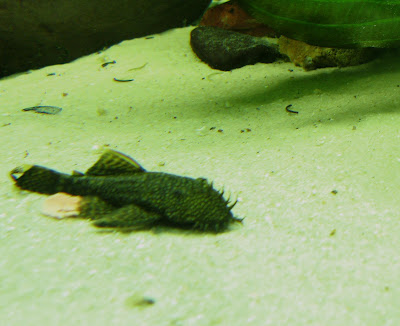 So, I am not sure what to do about this. The bristlenoses have plenty to eat - they have their choice. They enjoy zucchini, bell pepper, seaweed and cucumber in the veggie clip, always present and available, they enjoy veggie wafers that are dropped in once daily, and they also partake of the sinking particles of food or pellets that were intended for the more carnivorous occupants. They eat everything, including algae on the wood and glass - the male today was obviously eating the floating particles of daphnia (from the frozen cube fed to the angels) out of the water column, which is an interesting sight to see from a suckermouth catfish.
Why would they feel threatened by the cories, or otherwise be trying to prevent them from eating? It makes no sense to me, but I don't guess it should. I am sure it makes perfect sense to them. There is no question that they are chasing the cories off, however. I may wind up putting this pair, or maybe just the male, in the 37-gallon fry growout tank to hold the cycle when I don't have any babies in there, and he can't harass anyone. I like having an algae-eater in the 150, though, but I also like the cories (spent real money for every darn one!) and want to be able to see them, and want them to try to have a less stressful life, as much as can be possible in a glass box in my living room.
I am glad to finally discover a good reason for the cories to be hiding all the time, and now I just have to decide what to do. I will have to research Ancistrus type species (I will check with Deborah but there are probably hundreds) and see if there is something, or even some other type of dwarf pleco that would eat algae and otherwise keep to itself and mind its own business.
 The domestic angels, Frank & Agnes, spawned again, a very nice sized spawn on their usual sword leaf. However, this apparently did not bode well for the remaining baby from the last spawn that I left in situ when I removed his siblings to sell (I left him behind because he was a bit smaller than they and I figured I'd give him another week or so).
I then noticed he was not coming out for feedings, and he was up in a top corner, uninterested in eating. Cichlids in top corners of aquariums are being harassed and are under stress - this is a very common sign and one that should prompt removal of said fish.
So, I did. I netted him out rather easily, as he must be too young to fear The Net. I was carrying him over to the adjacent 37-gallon growout tank when Liz's Evil Twin grasped her by the ear and dragged her downstairs briskly, and thrust the net into the 150! Oh no! What has she done?!
I had a momentary lapse of judgment, OR, this is no biggie - the jury is still out. There is plenty of room in the 150, and this baby looks remarkably like a wild scalare, with the slightly turned up nose and the bold stripes on silver. He has a very, very prominent dorsal fin that has a red tinge. He's gorgeous and though I should resist trying to keep fish that I'm supposed to be selling, I could not resist (newbie!). At some point I will learn.
My actions will inspire scorn from the purists - if you are keeping wild-caught P. leopoldi angels, they should have a dedicated setup, the correct biotope, and ought to be properly bred; they should certainly not be mixed with common domestics. Tsk tsk. It is like mixing Endler's with fancy guppies, or even, as the very serious hobbyist would no doubt think, like a major metropolitan zoo breeding a tiger and a lion together for one of those charming (!) ligers.
I have no idea if the leopoldi will breed for me and see no sign that they will (Heiko Bleher says they won't in this setup due to the water that is too hard and alkaline for them - I tend to believe him), and mainly just want an attractive display. I will be able to easily remove this individual fish if there are any problems, since he is so different from the r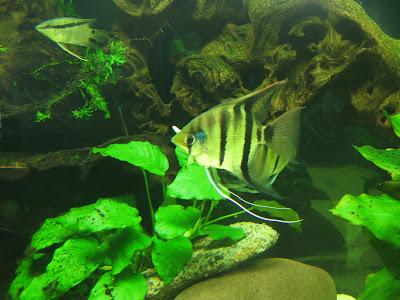 est, but given the amount of room available in this tank I wanted to see how these babies would turn out. He seems to be a real stunner so far, almost the size of a quarter. I have tried to get some pics of him but no luck yet - he's spending a lot of time in the weeds right now, as the most diminutive cichlid in the tank. His amazing sail of a dorsal fin, perfectly erect vertically and quite broad, makes him appear bigger than he is, and that gives him an advantage.
After spending some time observing the goings-on in the 150, with the new additions of the festivus, I see that these charming little guys with the racing strips are rather tough customers, as I have been warned.
I note that since the addition of the single festivus a while back that I have not had the number of Endler's babies that I typically see in this tank. I have to net Endler's out of this tank from time to time, trading them and giving them away, and I have not had to do that since putting in the festivus, even though he's barely 2" long. OK, that's fine - I had too many Endler's in the past, and was disappointed that the wild caught angels did not reduce their number like I hoped. The festivus is up to the challenge.
Enter two new festivus. Feisty little fellows! They are lunging towards Endler's, they are lunging towards cardinals (someone on a forum commented recently that I might find myself without any tetras as the festivus matures) and they all seem quite interested in eliminating the snail population.
Hmmm. OK. I'm cool with this, actually. I won't cry if they wipe out the Endler's population -they are not appropriate for this tank anyway, and I can start a dedicated setup easily if need be - no problem. I have enough friends and relatives with my Endler's offspring that the group won't be lost forever. Better to not have a population explosion that is not being dealt with. I'm a bit torn about the cardinals, though. They get along famously with the wild angels - no sign that the angels have even the slightest piscivorous tendencies - and they look SO pretty. That will be a trick to get over, but I recognize that they might be eaten by the festivus as they reach mature size. The festivus have already shown strong tendencies towards hunting down small fish. I will have to switch to a larger, swifter tetra, and there are many species to choose from, so this won't be a big deal. I'll get over it! I still love the festivus, and want them to work out in this large tank.
Or, more correctly, "Festivus for the Rest of Us." Festivum is an old moniker that I have trouble giving up.
Yesterday I spotted some very fine-looking M. festivus types at the LFS. They had excellent color, good size, and were reportedly eating anything that went into the tank.
Several months ago I expressed an interest in getting more when talking to the people at the shop, since I took all they had (3) and subsequently was left with only one, but as time went by they did not get any more in, and I thought I might just stick with the one, since they are likely to get bigger than the leopoldi angels, and I did not want pairing up of that species in this tank.
Lo and behold, they got more in. The chap told me he ordered them "specially for you..." and I immediately felt guilty! I should not have - these fish move pretty well for them, and they were stocking them long before I came along, but...... I was tempted. They really are very nice looking fish.
I went home and decided to trade some angel babies for the festivus. Today I netted out 4 of my largest babies, which could be considered quarter-sized, but not quite. I was hoping for a good price for them. They were very well received, and even though I was quoted a price much less than the price of the festivus, he took the 4 angels in a straight trade. He commented about how nice the angels looked, and how they had red in their dorsals, which is not often seen in domestics. These really do look more like wilds than you commonly see in the shops, so I know they will be good sellers. He wants all of them, and I assured him I had many more.
I am going to sell a few more that are of a decent size, but I still have many that are extremely wee, and I hope they will grow as the tank thins out a bit. Once they get a bit more size on them I will be happy to pass them on. This has been a very interesting experience, and I look forward to future spawns by Frank & Agnes. They are throwing very fine-looking fry, with hardly any culls.
What kind of plants are good for a beginner? This depends entirely on the light available. If you have a typical hood on a typical aquarium, the lighting is likely going to be considered low, and that's fine to start with. More light almost always brings unwanted algae, and algae problems can discourage a fishkeeper enough to tear down the tank and post the thing on Craig's List.
If you start out with low light, you have options. The tried and true species are Java fern and moss (Microsorum pteropus and Vesicularia dubyana, respectively), Anubias, Cryptocorine, and Aponogeton bulbs. The javas and Anubias species do not use roots in substrate, but rather are tied to structures or jammed into crevices, where they will attach themselves. That makes them great for camouflaging filter intake tubes and other equipment. You can also try stem plants like Hygrophila species but they often get a leggy appearance without enough light. Floating hornwort is a fabulous nutrient hog, but can also have slightly higher lighting requirements, and when it does not have enough, its tiny leaves make a real mess in the tank. The last two plant types have been outlawed in many areas because they have invaded local waters and have choked out native plant species. See what is available in your area, or what you can get from other hobbyists. Plant a lot of plants and see what works in your tank.
Check out sites like Plantgeek.net are a great source for information about plants. You can select the light level you are dealing with and get some suggestions. However, I'd strongly recommend the plants listed above, since most shops carry them and they are not difficult.
I would like to bring up the concept of undergravel filtration. I am not a fan. I do, however, think they can be beneficial in a non-planted, rocky type African tank when it is used as a reverse filter - water is forced up through the gravel from beneath. This keeps the substrate clear of debris, lifting anything resting on it into the water column to be picked up by the main filter. This is not practical in a planted tank, where you would not want to disturb root growth and there are too many obstructions in the tank to make it function properly.
For the same reason I would not use a UGF in a planted tank. The roots need to be able to grow in the substrate, and they'll clog up the filter plate beneath the gravel. Then there is the unavoidable situation of detritus collecting beneath the filter plates, which at some point needs to be addressed, and generally requires a complete tear-down of the tank to accomplish. That will almost always involve re-cycling of the tank, though not always.
There are so many filtration options these days, and alternatives to gravel as well. Don't tell anyone, as many would argue until they are blue that I am wrong (I very well may be), but it is my secret belief that the only purpose of typical aquarium gravel is to aid in the use of an undergravel filter, where the coarse texture keeps most large debris from falling down to the filter plates, but at the same time allows good movement of oxygenated water through the gravel, building bacterial colonies. Now that those filters have gone out of style, so to speak, everyone is still clinging to the use of gravel.
It is coarse and allows much too much debris to collect in it, no matter how diligent you are with your gravel vac, and it is a poor plant substrate (not horrible, just poor). Finer gravels and sands are what I prefer, though it has been only in the past 5 years or less that I have come to this conclusion. I have abandoned gravel to be used in the tops of my potted terrestrial houseplants - it covers the ugly dirt just great!
I have received some questions that I would like to address, with the first being the proper cycling of a new aquarium. Keep in mind this is all anecdotal - I am not an official authority on the topic and have no fancy degrees - I am simply relaying information that I have verified through my own experience over 25 years. I have killed a lot of fish in my time! ;-p
If you set up a new tank, get the filter running, substrate in place, heater going, plants planted, etc., you are not technically cycling the tank. Even if you place beneficial bacteria in the tank it won't be cycled without a source of biological waste to feed it. The bacteria will die and you'll start over, with the process not beginning until you have a source of nitrogenous waste that will feed bacterial colonies.
However, if it is a planted tank you desire, there is a lot to be said for getting the tank "established" with plants - a LOT of them - prior to adding fish. Plants need nutrients as well, but they can certainly get started, especially with the judicious use of fertilizer, sparingly. The more plants you have to start with the better things will go in the tank. It is typical (I have done it plenty of times) to plant a few plants and assume they'll grow, fill in, and slowly create the look you are going for. I am of the opinion that a cycle goes much easier if you have a ton of plants. Go ahead and load 'er up.
Another benefit is that this will hopefully obviate the evil algae issue, as the plants will be starving out any algae spores that are present (they're there, trust me, just waiting for an excess of one or more nutrients and any available light). If you DO have a source for beneficial bacteria, such as gravel, I'd place it in the filter, if your filter is one that can accommodate it (in a piece of pantyhose or similar bag) and do so when you add fish, stocking slowly so as not to overburden your beneficial bacteria. I don't find that placing bacteria-laden gravel directly on the bottom of the tank will assist the cycle in the most efficient way, since water needs to be moving over and through it quite well for it to flourish. Once the tank is established there is plenty of bacteria on and in the substrate, but for the purposes of cycling some oxygenation is helpful.
Some of the best bacteria that you can get from an established tank would be found on grody, gunky, slimy, nasty filter floss. That stuff is gold. That is what I use to cycle new tanks, and is one of the benefits of having more than one aquarium. You can cut the floss off of a used filter cartridges and rubber-band it to the frame of another, putting that in the new filter, or if your filter has a compartment for media you can just stuff it in there.
Again, this bacteria is valuable and you don't want to use it in an empty tank - it will simply die. Put it to use when you stock the tank. Start off slowly with hardy fish. It is impossible to describe the ratio of your beneficial bacteria culture start to a specific number of fish, but don't try to stock fully right away - depending on the size of the dirty floss you robbed from another tank, you could start with, say 3-4 platys for a wad of bacteria-laden floss the size of your entire hand.
There are also commercially available bacterial starts, my favorite being Bio-Spira (Marineland). This you add straight to the tank water at the same time as you are stocking your fish. It may take several days, but you are not going to have the drawn-out 6 weeks (plus) of cycle that is harmful to fish. I have done many tests with this product and use it anytime I do not have bacterial cultures already going, like setting up an aquarium for someone after I have recently cleaned out all my own filters, for example. With Bio-Spira you have the benefit of fully stocking the tank from the start, though I do not advocate doing that. (I do not work for or have any interest in the Marineland company, lol, just a satisfied customer)
I have learned over the years that aquariums attain (and require) balance, and this can only be achieved with Tincture of Time. I am not a patient person, and frankly I don't know that many patient people, but this hobby demands patience. A lot of it. Months of waiting. When I got my 150-gallon you can believe I wanted to slap a gillion fish in there pronto. It is hard to resist.
If at all possible, things will go SO much better in the long run to start out with the no-brainer, tougher fish, typically the schooling fish, and let them be for a couple of months if you can. It takes time for a new tank to settle and achieve balance, and you can't rush it. You'll have far fewer fish deaths if you can restrain yourself.
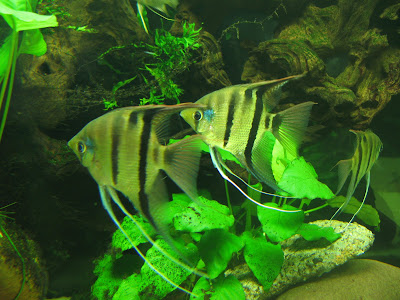
 Here is a very nice photo of the leopoldi my husband got with his iPhone. Check out the blue opercula!


