Still waiting. This is actually not so bad - the fish are happy and cavorting around, and I don't have to do hardly anything. No wringing of hands, no anxious examinations of potential signs of illness, nobody off their feed, no algae, no cloudy water, just status quo. When the Africans come in it will be a different story, and I will be Nervous Nellie once again, but for now we just test the water and wait.
My husband had a suggestion, and it really demonstrated how much he has learned about a hobby in which he takes ZERO interest, and often seems to baffle him. He wants me to put a rock or two in the 150 from another tank, or run one of my many duplicate filters on the 150 for a little bit and try to jump-start the bacterial colonies. What brilliance! I have been avoiding doing this very thing (I have not cycled a tank the old-fashioned way in YEARS!) but I was actually wanting to see how it went, rocking it old school, so to speak. I just think it shows that some of this stuff is really sinking in with Rick, and I was very impressed that he came up with this (so was he).
Anyway, I decided to humor him and I put in two smallish rocks from the 40-gallon leopoldi tank and we will continue to test the water, and Rick can see for sure what affect this will have. I was a bit leery about moving these rocks, since this tank has quite a few Malaysian Trumpet Snails that I don't want in the 150, but I scraped everything off the rocks that I could see. Likely as not the 150 will become infested with MTS anyway - such is life with this particular snail species. I don't have any other large rocks that I am willing to move that might have less potential for transporting vermin. I mean snails.....
I could move the large glass chunks from the 37-gallon, but they do not have very much surface area in spite of their size, being completely nonporous and smooth, and also the leopoldi pair in that tank has just now started coming out into the open since being moved in there a few weeks ago, and if I go rummaging around and removing structures they will take to hiding again, and I hate to stress them. Wild caught fish have to be handled with kid gloves sometimes. I sincerely doubt I will get a spawn from them, but I needed to thin out the group in the 40-gallon and I have become so attached to these fish that I'm content to keep them in their own tank (I am positive it is a male and female, with one male and two females in the 40-gallon, plus the domestic of unknown sex).
So, we'll see what happens with the small rocks, and maybe I will move one of the extra canister filters from the 40-gallon to the 150 for a week or so and see what it does to the nitrite value, mainly so Rick can see that he was right, and validate this little chemistry/biology lesson. I think every science class in middle school ought to cycle a fish tank. Things like temperature and pH will influence the progress of the cycle, and you can get as geeky as you like with it depending on the age group. It would also drastically limit the Failed Fishkeepers of the Future. This group is vast, an epidemic, really, and though a reduction in membership would mean far, far fewer cheap tanks at yard sales and on Craig's List, more people would find success and we could raise the geek quotient. I'm just sayin.
I have not mentioned Otis the puffer in a while, but he's The. Best. Fish. Ever. He's fat and a good solid 2", probably his full size. He enjoys his brackish tank that is open on all sides to the room, and is wickedly overfiltered with an AquaClear 70. Yes, I said 70. As mentioned long ago I had great plans to transition Otis to a 20-tall setup, which is a huge space for a 2" fish, but after having him for at least 18 months now there is no question that more water is better for puffers. He is a voracious eater, and even has nipped me when he's hungry and I reach in to do maintenance. He is always hungry, by the way. He has nice bright blue eyes and an almost fluorescent green pattern to his Figure-8, so I know he's healthy. His tooth plates seem well maintained, with about 90% of his diet being snails, which I cultivate avidly. Ramshorn snails, specifically. Woefully, MTS are much too hard for him to manage, but if he could eat them I'd have plenty.
I have coral rock in the tank with a bit of java moss that is miserable, and one remaining sprig of java fern that is perhaps even more miserable than the moss. I don't know why I can't grow brackish-friendly plants in this tank, but I have a horrible time. The tank is lit by a 13w CF bulb, plus overhead fluoro lighting sometimes during the day, the temperature is good, etc., so I'm not sure of the problem, but I don't sweat it too much. The tank looks like a SW setup with the coral anyway, so plants don't look particularly correct, though the java fern has a marine algae-like appearance that works. I have made arches and caves in the middle, so he goes through them to get from one side to the other. This gives him something to do. I think it would be good to build up the central structure a bit higher for more architectural interest for him. As long as I rearrange the furniture from time to time he is kept content. I am enjoying this fish immensely, in case you can't tell! I worried about getting him at first, since I'd never kept brackish and I'd never kept a species with such particular needs before, but it is working out okay.
Wednesday, September 1, 2010


Sunday, August 29, 2010
Jeopardy Music = Waiting

Nothing new to report - the tank is experiencing a nice nitrite spike, and in the presence of nitrate that means we won't have much of a wait. The goldfish are happy and look healthier than ever, with careful PWCs and a LOT of water for them.
Many, many people disagree with using fish to cycle a tank, and woe unto you if you dare discuss doing this on an aquarium forum!! (Go ahead.... I dare you! :)).
There are many species of fish that cannot tolerate this process, but there are several that do. I have used ammonia to cycle a tank, the rotting shrimp method, fish food with no fish method, etc., and in a small tank frankly I would not use fish to cycle it unless they were extremely small ones (like Endler's or very small guppies) - it is close quarters and the effects of ammonia and nitrate are quite stressful to the hardiest of species. I have enough tanks running that I could start a decent sized tank with filthy filter media from my other tanks, but I don't have enough to get a 150-gallon started, and I have found, in this particularly large tank, that hardy fish tolerate the cycle.
So we will sit back and wait. This last part of the cycle can linger on and on for weeks, so patience is tested at this stage. Patience is not one of my strongest traits (!!) but there is no way I am going to put an expensive Tanganyikan in this tank until the water is very stable. They are extremely sensitive. When I was keeping calvus (one of my favorite tanks setups) even though I took care to keep the water change water as close as humanly possible to the tank water, with once weekly changes on a strict schedule, the fish would lie down on their sides on the sand every time I changed the water. Obviously there was some parameter that did not match, and the slightest thing sent them into dramatic exclamations. This did not seem to have any long-term deleterious effect on the fish, but I always felt horrible. I did not have this happen with N. brichardi/pulcher or with N. leleupi.
At any rate, the goldfish are showing no fin damage, no change in activity (can't get a decent still shot of them ever) and are eating like pigs so I'll soldier on. They look pretty cool in this tank, and I try to imagine what it would look like if they were much larger in this same tank (it would look COOL) but that is a tank for another time. This one is slated for Africans, specifically deep water Lake Tanganyika Africans, so I look forward to the day in the coming weeks when I can proudly post pics of my shiny new black and white with blue striped baby frontosa. Or Kodak box yellow leleupi. Or golden-headed compressiceps... spotted calvus... Ahhhhhh.....
Saturday, August 21, 2010
Goldfish? Dew Whut?

Here are some goldfish in the new setup until I decide what to do about the Africans. The pH is very nice and steady at 8.1, compared to 7.4 out of the tap. This is completely the result of the aragonite sand. I'm going to leave the goldies in residence for a couple of weeks and then order my frontosa.
I'm reading more and more about them and it seems that the best bet is to have no tankmates - they can be either nippy and damage the trailing fins, stressing the fronts, or they will be too small and become meals for the fronts.
I think I might try a colony of N. leleupi, some of my favorite Lake Tang species, and see how it goes, especially while the fronts are small.
Friday, August 13, 2010
Liz + Rocks = OCD

I redid the rocks, again. I think if I'm not soaked to the armpit and pruny then I just don't feel like it has been a good day.
I scared up a few much larger stones to complement my plethora of small ones. I spent several hours stacking, restacking, adjusting, adding, removing, and scratching my chin and squinting at the tank.
Now I am happier with how it looks, though a rock background would really make me happy. That, however, is for another day. I will let the tank run for a while, but possibly I'll add some black mollies to see how things go. I have cycled this large tank with fish before, since the ammonia and nitrite are so diluted that the fish do not seem to stress or suffer, it seems.
I do not want to spend $$$ to ship delicate species (seems like Lake Tang fish are much more sensitive than other cichlid species, and thereby are always more expensive) and have them all keel over after being added to the tank. I need to put some inexpensive fish in there to ease my mind that all is well. The problem is that I will then need to remove said "test" fish and that might be quite a trick. Maybe I'll use the goldfish in my 37g and be sure they do okay, and they are easy enough to net out as they come bobbling over to see what that net thing is all about. I'll sit tight for now.
Thursday, August 12, 2010
Leopoldi Crammed into a Closet

Here is a pic of where the P. leopoldi now reside, though it is too small for them all and I'll need to split up the group in the near future. I like this tank, in spite of my previous comments about all my tanks being overplanted with no room for fish. This is a 40-gallon breeder and was the quarantine tank for these leopoldi when I got them.
Het rasboras and ember tetras are in residence as well as a balloon ram. I'm not proud to own such a fish (I'll admit I'm a snob and prefer my aquarium fish to be close to what is found in the wild - long-finned this, albino that do not appeal to me typically), but she was very pretty and I've never had luck keeping rams and hoped I could do it this time. I lost the male but she's been holding her own for quite a while now.
There is also one domestic silver/wild type in with the leopoldi and you can hardly tell him apart from them, except he has red eyes, leopoldi do not, and his nose has a bit of an upturn, whereas theirs is turned down a bit.
Apocalypse
The 150 is emptied and reconfigured. I had quite an adventure in the process. Netting out each species for relocation to various locales, arranging meetings with other hobbyists and even turning in unwanted individuals for credit at the LFS, all accomplished in a day. Then I had to deal with the play sand. I highly recommend regular play sand for most any tank - it is very fine and soft so appropriate for the delicate barbels of catfish.
Aside: This is a very important aspect to keeping cories, in particular, and one that is very often overlooked! If you have cory cats in a tank with gravel, you will likely find the cories have a shorter lifespan, unless you observe meticulous maintenance habits. These fish sift through sand in the wild and they will very much appreciate sand in their habitat. There are many aquarium sands that are sharp and can damage barbels, so choose carefully. Play sand is one that works very, very well. *EDIT: Be aware that this is my own personal opinion. I can't say, truly, what cories "like" best, but I prefer to use sand for them, and soft sand that is not sharp.*
Back to the story! Why, you ask, do I not simply keep the play sand for my Africans? Well, originally I had planned black sand substrate, so I intended to remove every speck of play sand. Somewhere along the line when I bailed on my background project and realized I would have a solid black background and dark rocks, I decided black sand would be overkill and white sand would be preferable. Since my rocks are river rocks and are not calciferous limestone (like I was planning at one time) I decided to use aragonite sand, which is a buffering substrate, and will help me maintain a pH closer to 8.
I recognize that the fish I will likely keep have been tank bred in the US and may never have seen water as alkaline as their wild cousins in Lake Tanganyika, but it is easy enough to use a buffering sand and give the alkalinity a boost. Couldn't hurt. I do not have plans to go to great efforts to buffer my water at this point. The other benefit is that the aragonite sand I purchased (CaribSea) is white white white, and offers a very nice contrast.
Ok. Here's how it went. The tank was emptied and cleaned out.


The filters were also cleaned down to new floss and completely scrubbed out to eradicate the MTS infestation, and replaced under the tank. Heavy job! On the left is the Rena Filstar XP4, and on the right is the Fluval FX5. On the far left is my CO2 tank and regulator, which is parked in storage there for now, as I won't be using it on this tank in the near future. I am keeping the pH monitor running, as that is handy.

I used the overflow box from when the tank was drilled to hide my large and unsightly filter intakes. If you look closely in the center of this photo you can barely make out the horizontal slits cut into the overflow box. The vertical PVC pipe is the strainer for the drain in the bottom of the tank, which came in VERY handy during the emptying and cleaning of this tank. At the beginning of this blog you can see how this was configured, with a hose bib on the outside of the stand. I connect a garden hose to that and turn the hose valve to drain the tank out the door, and I used another garden hose connected to the outdoor faucet and washed out the tank, with the water going down the drain. Love that. The overflow box is not siliconed in place, but stands quite firmly in place with tiny gaps next to the glass to allow better water flow. I may wind up adding more slits to this box to increase flow to the intakes, but we will see how the filtration looks. I have quite a bit of flow in this tank and don't think the box gets in the way too much. It is very effective at hiding the intakes, and it blends right in with the black external background.
Here's where I started stacking rocks and adding sand.

The sand was just a bit problematic. I read up on it and decided not to rinse it first, since I wanted to keep all of the buffering properties. Everyone says how it "clears up in a few hours...." It didn't. I had to drain and refill and rinse the sand in the tank after all. This is not much of a problem, though, with my drain hose as described above.
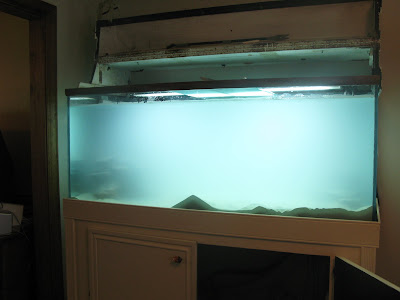
Cloudy. Hmm. Better drain and fill one more time. This time I'll use the Python and fill it from the sink as well as use a garden hose from outside to make things move along more quickly. Oops.

Oh well - no worries! We have technology to suck water off the floor! *Ahem*
Anyway, I kept at it and finally it started clearing, and I started playing with rocks. I have to say I'm not entirely happy with these rocks, as they are too small and it makes the tank look cluttered in spite of the spare decor.
I redid it several times. And redid it several more times.... I had to stop because the wet arm and sopping shirt gets annoying after a while.
OH! I forgot about the lighting! I'm very pleased with that. I used "puck" lights from an under cabinet fixture. Each puck is daisy-chained together so you can add or remove a fixture as necessary. The fixture I have came with 4 pucks, each connected with a removable wire about 12" long. I installed them randomly in the hood. Each puck is about 3" in diameter and has I don't know how many individual LED lights.
Here is a shot of the lights. I have since taken out all but two of them (this tank needs to be relatively dim), though the fixtures are still there. The frame is screwed in and connected by the wires, but the actual light component can be unscrewed and removed, without the other pucks going out. Love this fixture, and it was under $20, unlike the LED fixtures made for aquariums ($$$$). I will install a small fan under the hood to reduce humidity that will no doubt damage this fixture.

I finally got the water to clear up after 4 days. Again, I'm not entirely happy with this tank at this point. I wish I had a DIY internal background, either some sort of real rock veneer or a carved styrofoam background coated in concrete and painted to look like rock, but I did not have the energy to deal with the styrofoam method and I could not find thin rocks that would 1) not be too heavy, 2) not break the bank, and 3) not look contrived or too deliberate. I don't really like the rock decor but they are growing on me.
I will put a trio of N. leleupi in there to start things off. Their bright yellow is going to show up very well in this tank, and they will love the rocks.
A word about the rationale behind how this tank is being 'scaped: C. frontosa are deep water Lake Tanganyikan fish and are accustomed to dim conditions. Again, I realize the fish I'll likely get have never seen the lake, and may have spent their entire fry-hood under fluoro lights, but I do think they will feel more comfortable in conditions closer to that of the lake. If you look on You Tube for Lake Tanganyika videos you will see what I mean. There are rocks and sand and that's pretty much it. Few plants, and certainly no driftwood and flower pots, lol.
I have kept aquariums for nearly 30 years now and as I've matured I've been leaning towards natural looking aquascapes, with lots of plants and wood and rocks and such, which is pretty, but it is one of the reasons I took down the 150 - I'm tired of the fussiness and overcrowded way I tend to keep aquariums: lots of lush plants layered together with artfully arranged driftwood and rocks, and hardly room for the fish. It is pretty but I yearn for a minimalist tank that is simple and clean. This will certainly be that! More later.
Aside: This is a very important aspect to keeping cories, in particular, and one that is very often overlooked! If you have cory cats in a tank with gravel, you will likely find the cories have a shorter lifespan, unless you observe meticulous maintenance habits. These fish sift through sand in the wild and they will very much appreciate sand in their habitat. There are many aquarium sands that are sharp and can damage barbels, so choose carefully. Play sand is one that works very, very well. *EDIT: Be aware that this is my own personal opinion. I can't say, truly, what cories "like" best, but I prefer to use sand for them, and soft sand that is not sharp.*
Back to the story! Why, you ask, do I not simply keep the play sand for my Africans? Well, originally I had planned black sand substrate, so I intended to remove every speck of play sand. Somewhere along the line when I bailed on my background project and realized I would have a solid black background and dark rocks, I decided black sand would be overkill and white sand would be preferable. Since my rocks are river rocks and are not calciferous limestone (like I was planning at one time) I decided to use aragonite sand, which is a buffering substrate, and will help me maintain a pH closer to 8.
I recognize that the fish I will likely keep have been tank bred in the US and may never have seen water as alkaline as their wild cousins in Lake Tanganyika, but it is easy enough to use a buffering sand and give the alkalinity a boost. Couldn't hurt. I do not have plans to go to great efforts to buffer my water at this point. The other benefit is that the aragonite sand I purchased (CaribSea) is white white white, and offers a very nice contrast.
Ok. Here's how it went. The tank was emptied and cleaned out.
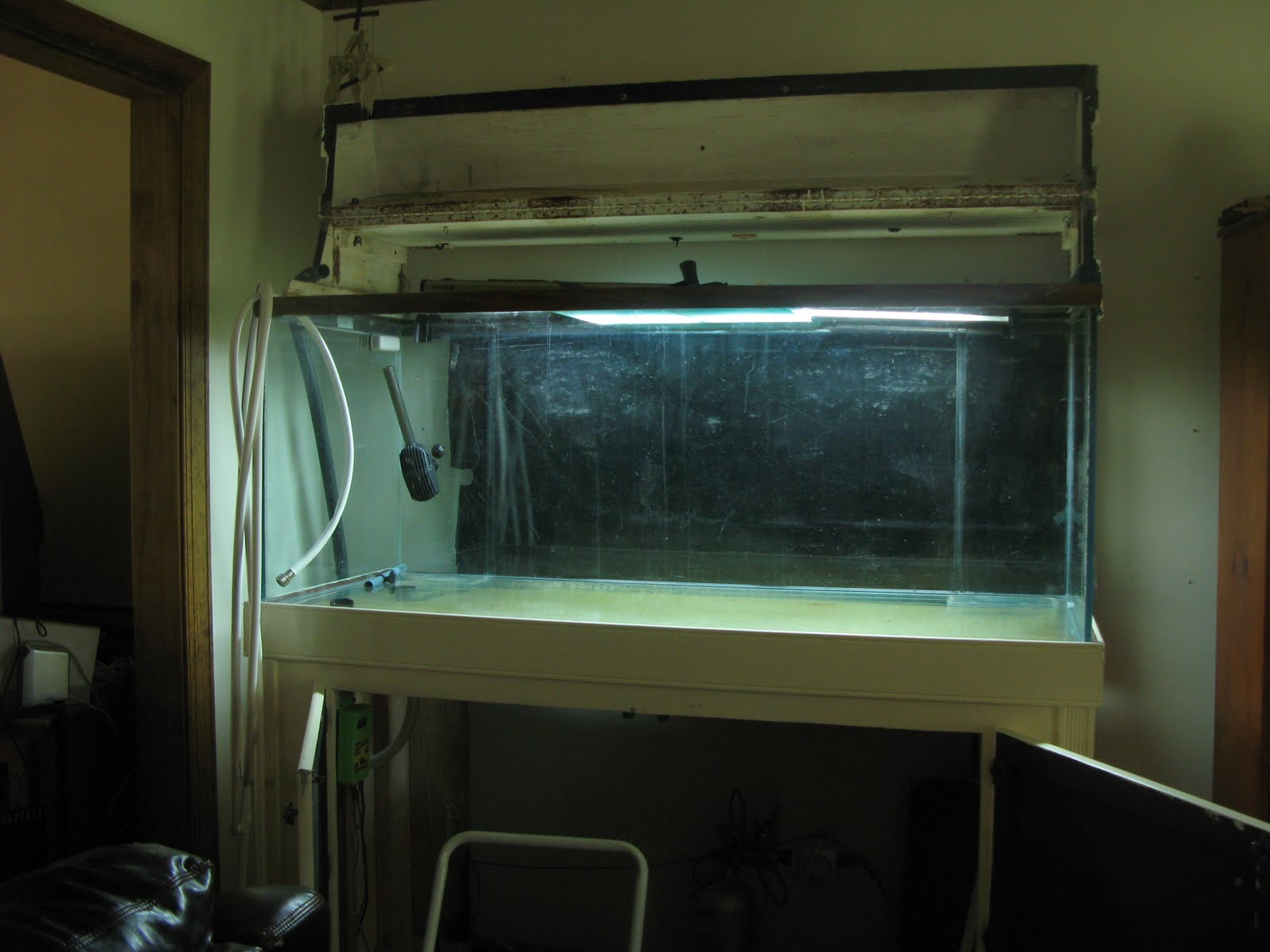


The filters were also cleaned down to new floss and completely scrubbed out to eradicate the MTS infestation, and replaced under the tank. Heavy job! On the left is the Rena Filstar XP4, and on the right is the Fluval FX5. On the far left is my CO2 tank and regulator, which is parked in storage there for now, as I won't be using it on this tank in the near future. I am keeping the pH monitor running, as that is handy.

I used the overflow box from when the tank was drilled to hide my large and unsightly filter intakes. If you look closely in the center of this photo you can barely make out the horizontal slits cut into the overflow box. The vertical PVC pipe is the strainer for the drain in the bottom of the tank, which came in VERY handy during the emptying and cleaning of this tank. At the beginning of this blog you can see how this was configured, with a hose bib on the outside of the stand. I connect a garden hose to that and turn the hose valve to drain the tank out the door, and I used another garden hose connected to the outdoor faucet and washed out the tank, with the water going down the drain. Love that. The overflow box is not siliconed in place, but stands quite firmly in place with tiny gaps next to the glass to allow better water flow. I may wind up adding more slits to this box to increase flow to the intakes, but we will see how the filtration looks. I have quite a bit of flow in this tank and don't think the box gets in the way too much. It is very effective at hiding the intakes, and it blends right in with the black external background.
Here's where I started stacking rocks and adding sand.

The sand was just a bit problematic. I read up on it and decided not to rinse it first, since I wanted to keep all of the buffering properties. Everyone says how it "clears up in a few hours...." It didn't. I had to drain and refill and rinse the sand in the tank after all. This is not much of a problem, though, with my drain hose as described above.

Cloudy. Hmm. Better drain and fill one more time. This time I'll use the Python and fill it from the sink as well as use a garden hose from outside to make things move along more quickly. Oops.

Oh well - no worries! We have technology to suck water off the floor! *Ahem*
Anyway, I kept at it and finally it started clearing, and I started playing with rocks. I have to say I'm not entirely happy with these rocks, as they are too small and it makes the tank look cluttered in spite of the spare decor.

I redid it several times. And redid it several more times.... I had to stop because the wet arm and sopping shirt gets annoying after a while.
OH! I forgot about the lighting! I'm very pleased with that. I used "puck" lights from an under cabinet fixture. Each puck is daisy-chained together so you can add or remove a fixture as necessary. The fixture I have came with 4 pucks, each connected with a removable wire about 12" long. I installed them randomly in the hood. Each puck is about 3" in diameter and has I don't know how many individual LED lights.
Here is a shot of the lights. I have since taken out all but two of them (this tank needs to be relatively dim), though the fixtures are still there. The frame is screwed in and connected by the wires, but the actual light component can be unscrewed and removed, without the other pucks going out. Love this fixture, and it was under $20, unlike the LED fixtures made for aquariums ($$$$). I will install a small fan under the hood to reduce humidity that will no doubt damage this fixture.

I finally got the water to clear up after 4 days. Again, I'm not entirely happy with this tank at this point. I wish I had a DIY internal background, either some sort of real rock veneer or a carved styrofoam background coated in concrete and painted to look like rock, but I did not have the energy to deal with the styrofoam method and I could not find thin rocks that would 1) not be too heavy, 2) not break the bank, and 3) not look contrived or too deliberate. I don't really like the rock decor but they are growing on me.

I will put a trio of N. leleupi in there to start things off. Their bright yellow is going to show up very well in this tank, and they will love the rocks.
A word about the rationale behind how this tank is being 'scaped: C. frontosa are deep water Lake Tanganyikan fish and are accustomed to dim conditions. Again, I realize the fish I'll likely get have never seen the lake, and may have spent their entire fry-hood under fluoro lights, but I do think they will feel more comfortable in conditions closer to that of the lake. If you look on You Tube for Lake Tanganyika videos you will see what I mean. There are rocks and sand and that's pretty much it. Few plants, and certainly no driftwood and flower pots, lol.
I have kept aquariums for nearly 30 years now and as I've matured I've been leaning towards natural looking aquascapes, with lots of plants and wood and rocks and such, which is pretty, but it is one of the reasons I took down the 150 - I'm tired of the fussiness and overcrowded way I tend to keep aquariums: lots of lush plants layered together with artfully arranged driftwood and rocks, and hardly room for the fish. It is pretty but I yearn for a minimalist tank that is simple and clean. This will certainly be that! More later.
Friday, July 30, 2010
Switching Gears

I'm afraid it's time to take it down! The 150 planted tank is scheduled for a makeover. I really hate to do it but I have to admit I'm bored. The setup practically runs itself and all I do is feed and do water changes. The fish are healthy and they all get along great. I've built my stock up and it is a very agreeable community. To recap, the inhabitants include:
- 5 wild caught P. leopoldi angels (2 males, 3 females as far as I can tell)
- 1 wild-type domestic silver leftover from some I bred
- 1 festivus cichlid (plant eater to some degree!)
- School of loretto tetras that inhabit the upper strata
- School of cardinal tetras and rummynose tetras that inhabit the mid and lower regions
- School of C. trilineatus
- School of C. sterbai
The plan will be to remove everything from the current setup (always save your decor, even if you don't think you'll use it again - you likely will) and net out the darling fishies. I would love to sell them to a hobbyist but I don't want to ship them and if I don't hear anything from my ad on Craig's List and the Exotic Fish Forum (many members local to me) then I'll take them to my LFS for credit. This is the shop where I got the leopoldi in the first place, so I know he knows how to care for them properly, and will hopefully find a proper home for them.
These are not very commonly imported and I would love someone to have them that knew about them and could look after them properly. If they are to spawn (which would be a real boon since the babies would go for a great price with their heritage) then you'd need to get the pH down, way down, in the 5's, and that would likely do the trick, at least according to Heiko Bleher, who was the one to positively ID these fish for me when he happened upon pics of them on a forum. If they are kept in higher pH they won't spawn, but they school together and live quite well in a group. For anyone who knows angels this is pretty much impossible when you have a group of mixed sexes. It is really neat to be able to keep a graceful group of good-sized angels together.
Anyway, after the fish are out and the sand is mostly scooped out I can then take a hose and flush out the last of the playsand down the drain my husband most thoughtfully installed in the bottom of the tank, since it had a hole drilled there already. It has a spigot on the side of the tank stand and if you attach a hose to that and run it out the door, you can scrub and flush out the tank to your heart's delight and not have to do any siphoning. I don't want a single speck of white sand to remain. In my 37g goldfish tank I had the same idea but was not quite able to get every bit of white sand out, and even though it looked like I had, now that I have black sand in there the white flecks are everywhere.
Then, I want to tip the tank on its side on the stand with the back of the tank facing down, and the top of the tank facing the room. This way I can silicone large flat, thin rocks to the back of the tank. I have visited the local landscape supply and they have some very nice rocks used as a veneer for faux rock walls and for fireplaces and such, and though they are heavy they would be appropriate. They will also create very subtle cave structures for the Altolaprologus calvus (or compressiceps) that I plan to add.
Where things get creative and perhaps impractical is that I plan to reinstall one of the overflow boxes in a rear corner to hide the filter intakes, outflows and the heater. It is black acrylic and was in place when I bought the tank, since it was drilled for a sump. I took out the boxes and siliconed thick glass over the holes since I was not planning that type of filtration due to my plans for plants. Now I plan to reinstall one of the boxes after sawing slits or drilling holes into it at the location of the intakes. There are already slots in the top where the outflow would be. I'm not sure if this will work or if it will impede filtration too much. I have a Fluval FX5 and a Filstar XP4 for filtration. I can also install a powerhead at the opposite rear corner to improve flow if that is a concern.
This overflow box I plan to disguise by either spreading it with silicone and sprinkling black sand on it, or gluing flat rocks to it like the background (that sounds better). This really depends on what rocks I plan to go with and how smoothly that procedure goes. I have read so many articles and forum threads about DIY backgrounds that I'm exhausted with the possibilities. Many people create them using styrofoam, using knives or saws to carve rocky shapes into it, going over it with a heat gun to soften the edges, then coating it with pigmented concrete or the like, to have a lightweight and removable background. Truth be told, if I'm going to be laying tarps down, with dust and bits of stuff flying around the house, cutting, drilling, sawing and mixing concrete I'd at least like to have a new kitchen when I'm done!!
This type of project is definitely up my alley, I must say, but these days I just don't have the energy or time to do it right. I also very much prefer the idea of natural rock. I know this is a somewhat permanent addition to the back of the tank, but I am not concerned. I can razor the rocks off just like I razored the overflow boxes off, and even if I go back to a planted tank the rocks will certainly be appropriate there as well, or even if I kept oscars or goldfish, for that matter.
So, I will then have black sand and a rocky background, and hidden equipment (huge, huge issue for me when aquascaping!). Next I will need a few large rocks for decor for the open part of the tank. This tank is going to have a simple, spare look to it, however, so I don't need much. What I'd like to use is limestone, since it will buffer the water and perhaps obviate the need for additives to boost the alkalinity. The tap water is already moderately hard with a pH of 7.4, so it won't take much to get things up to 8, but that's where I'll need to be.
At the same landscape supply yard (Pete Rose's in Richmond - awesome place) I found some limestone rocks that would be perfect, and they also contain tiny fossils that would likely show up very well when wet. These rocks are variable in height and dimension, but look easily stackable. I want to be sure to get at least one relatively tall rock or rock stack, since in such a deep tank you need something to draw the eye up to the top of the tank. I don't need but a few of these rocks, then I'll be done.
We are heading up to the mountains of Virginia for a day hike on Sunday and I hope to collect some rocks there as well, so my final decision will depend on what I see up there. Mostly what you see there are round river rocks, which may or may not work for me, but I'll see what I can find.
Once the tank is up and running I will want to stock with about 8 frontosa (not sure which type) as well as calvus or compressiceps, depending on availability and variety. I much prefer inkfin calvus but they might be practically invisible in this dark tank, so I'm leaning towards some of the lighter morphs, or the compressiceps species. This is going to be costly! I might have to do it in phases, depending on available funds and what I can get for my current stock upon turning them in.
I will take pictures along the way and we will see how it goes!
Friday, April 2, 2010
Festi-Wha??? Or, The World's Worst Blogger Picks Up the Story

Well, back again for another update. The festivus in the 37-gallon DID spawn for me, and in a big way. There must have been 200 babies. Note in the photo the clamped fins and stress bars - the parenting thing really taxes the resources of these fish, apparently. They are very nervous, and prone to attack anything, including the Mag Float algae scraper, siphon hose, my hand, whatever. This is serious business.
The rummynose, which I have determined to be H. bleheri , were moved down to the 150 and are very, very happy there. They school with the cardinals and all is well. I very much like the visual interest their markings add to the tank, especially in contrast to the vivid deep colors of the cardinals. It has now been 3 months or so and I have not lost a single one of them, and have not lost any cardinals, either, which is unusual for me!
Back to the festivus. The babies grew, and the parents became more and more nervous as they spread out, in spite of the adults' efforts to keep them corralled. I don't know if I mentioned that also residing in the 37 is a Chaetostoma sp., whom I have named Chet, and I'm baffled as to why I purchased him! He's adorable, that's for sure, but it was an impulse buy, and anyone who has been in the hobby for any length of time knows that impulse buys are doomed to failure, in most cases. Chet would prefer cool waters with lots and lots of current, and though there is a lot of water movement in this tank the temperature is a bit high. However, I needed it so for the babies, which will grow faster and reach sale size more quickly.
Things were rolling along like this for a good while until the adult festivus, whom I dubbed "The Thugs" (I am not fond of these fish, having a thick, pugnacious appearance and aggressive personalities) spawned again. This caused confusion, and they started eating some of their first spawn in response to the arrival of their new batch of wigglers. No biggie, I thought, since there were WAY too many babies to grow out in this tank anyway, and I wanted to see what would happen. I did not have another tank to move the babies into, and no time to raise fry myself - if I was going to keep a breeding pair I require them to raise the babies, like the angels, Agnes & Frank, did so well.
Well, they ate the second spawn, and over time, perhaps several weeks, I began to lose more and more fry from the first spawn. At this point I was rather disgusted. Not only with these fish, which I did not particularly like (I DO, however, very much like the festivus that remains in the 150 with the wild angels, as I believe that fish is a different species and has a lovely, graceful appearance and a peaceful personality), but also with the tank itself, which had become overrun with algae of every description, and finally cyanobacteria. I have to blame the 24/7 lighting and the excessive waste in the tank due to the feeding of so many fry. You wind up putting a lot more food in the tank so all the babies will get access to it, and even with frequent PWCs you could tell there were way too many nutrients. I got some anacharis (not one of my favorite plants but in the right conditions grows like a weed and sucks up a ton of nutrients from the water column) to hopefully help with the algae and provide cover for the fry. This was left floating, and worked pretty well, thriving on the lighting and the abundant nutrients.
Also, pretty much the minute The Thugs spawned the first time they terrorized Chet, driving him into his cave network just about 100% of the time. I dropped food back there and he was eating, and after about a week of debating what other tank he could go in, I decided to just leave him be and see how he fared, and keep him there until I decided what to do. He adapted well and seemed to do fine. He was not a good choice for these cichlids, though I thought he'd make a perfectly fine tankmate for them.
Next, the cyanobacteria began taking over, and the tank looked a wreck. It was getting too hard to keep things under control. I made a big decision: I would take The Thugs in to the LFS for cash or credit, raise whatever babies were left, and then turn the tank into a goldfish tank. Raising fry seems profitable to me, as I did get good money for the large spawn of the angelfish Agnes & Frank, but I think it is a wash in the end after you consider the cost of food and increased PWCs. It's fun, but I don't really have the time, and I basically need my tanks to run themselves.
I thought I'd try to leave the anacharis and anubias in the tank (goldfish are notorious plant eaters but may leave these species alone), remove the driftwood, which was decaying and contributing in a big way to the excess DOCs in this tank, and switch to black sand. There is a black background, and I thought this would be a nice contrast to whatever goldfish I wind up getting. I can then lower the tank temperature to better suit Chet, and hopefully he can dwell with a couple three fancy goldfish in peace.
I caught The Thugs without difficulty and took them in. I am fortunate to have three LFS that will take my fish just about anytime, so that was done, and I was glad to be shed of these two. Sometimes certain fish just don't make me happy, and these two were those fish. I returned to the tank to assess how many babies were left, and was surprised to see I had only three left! Oh well. What now. Do I keep this tank going and raise the three? Get rid of them (they are about 5 mm long), OR...... put them in the 40-gallon angel tank?
Now, about that tank. I am sad to say that I lost Frank last week, apparently suffering from dropsy or something similar. The conditions in this tank are pristine, with very heavy plantings and a rigorous maintenance schedule, but for whatever reason he got sick and died. I could have removed him to a hospital tank and medicated him, but I have not had success in the past doing this, and you have to consider the stress of moving him combined with the cost of medications and time and energy, and..... oh well. He gave me one fabulous spawn with Agnes and that was a great experience. I still have one of their progeny in the 150 with the angels, and he is now about as big as the leopoldi. He's a very handsome fish and I'm proud of him.
Anyway, I thought I'd take Agnes in as well and completely restock the 40, but then I decided that she's such a nice fish (very attractive, IMO) that I'd just get her some schooling fish, maybe some type of catfish, and create a mixed community around her. The plants are doing very well in this tank and I hated to redo anything. SO, to make a long story longer, I decided to put the three festivus babies in with Agnes and hope for the best. The plants are so dense that I am hoping at least one will survive, and maybe I can keep one in there. This is depending on the plant-eating tendency of the fish, however. In the 150 the festivus has caused a great deal of damage to the "red rubin" sword plant that is a centerpiece of the tank, and there are holes in most of the other plants. They also tend to be snail-eaters, and the 40-gallon continues to be a snail farm for my dear figure-8 puffer, Otis. This may or may not work out, but we've got plenty of time to see what happens.
 Well, above is what we have in the 37-gallon today. The Estes black sand is down, Chet's cairn/cave is augmented, and I added a piece of solid glass that is about the size of a football. This is waste glass from a glass factory, and is quite interesting. It is very sharp and jagged, but looks like ice in the tank. Chet seems to be holding his own after the redecorating and I am now ready for a couple of small fantail goldfish, I think. I hope they leave the plants alone but I'm ready if they don't. I have some pieces of slate that I thought I'd add, but when I put them in there I just don't like they way they look - even though they are broken they are too uniform looking and do not have an organic appearance, so I took them out. If the plants are wiped out I may need to rethink things, but we'll try it like this for now. I cut the temperature back to 76-78.
 Above is the 40-gallon today. Agnes is somewhere in there, lol, but I just turned the lights on for the photo and she was still in the sword plant where she sleeps. I know it is very much overgrown but I like it. I might get some sort of schooling fish next - not sure - but for the time being it will remain Agnes' domain.
As for the 150, I wound up taking out both Ancistrus, since the male was too, too aggressive, charging at all of the other fish in the tank and keeping all of the cories in hiding. It was quite unusual behavior for this species, from what I understand. I then added another half-dozen C. sterbai since I had a credit at the LFS and they had some on hand. They are lovely little things.
Here is a short video (I was trying to capture the aggression of the bristlenose) of the 150, and in it you can see the red rubin sword in the back to the right, which is full of HOLES! It is a horror, but I can't bring myself to get rid of that lovely festivus, which is otherwise a perfect citizen in this tank. Note the difference in his appearance compared with The Thugs. Night and day.
Subscribe to:
Posts (Atom)


